
AI in Regulatory Affairs
The regulatory affairs professional of the future: what humans should own and what AI agents should do
The future of regulatory affairs is not human versus AI. It is a better division of work. The agent should take on finding, checking, comparing, organising and monitoring regulatory information. The RA professional should spend that time interpreting evidence, deciding strategy and standing behind the outcome. Here is how we think the work should be split, and where the line must hold.
Written by RafiHive Regulatory Team · Published 16 October 2026 · Last reviewed 16 October 2026
Sources: EMA · European Commission
Where the time goes in regulatory work today
The future of regulatory affairs is not human versus AI. It is a better division of work. An AI agent should take on the time spent finding, checking, comparing, organising and monitoring regulatory information. The RA professional should spend more of their time interpreting evidence, understanding context, deciding strategy and taking responsibility for the outcome.
Anyone who has worked in RA knows where the hours go. A question arrives, and before anyone can think about it, someone has to:
- search EMA, CMDh, European Commission and national authority pages for the sources that apply;
- check whether the guidance found is current, superseded or still a draft;
- compare the current version with the one the team last worked from;
- find the relevant entries, sections and conditions inside long documents;
- pull the requirements out and match them against what the dossier contains;
- assemble the source links for the file note;
- write a first-pass summary someone else can review.
All of that is necessary, and all of it has to be right. It is not where an experienced regulatory professional adds the most value. We train RA professionals to understand medicines, procedures, legislation, evidence and risk. Then we ask them to spend hours looking for PDFs.
The claim is not that AI makes regulatory work 'ten times faster'. It is that delegating the repetitive evidence work can make it faster, more consistent and easier to verify, while judgment and accountability stay human.
This is not about replacing junior work
The tempting version of this story is simple: junior RA work goes to the agent, senior work stays with people. We think that is the wrong distinction, and a dangerous one.
Junior professionals do not only produce first drafts. They are learning why a source applies, how procedures fit together, how to recognise an exception, what evidence is missing, and when an answer that looks obvious is actually ambiguous. An agent that hands them conclusions might make them faster. It would also make them worse regulatory professionals, and in ten years there would be fewer seniors who learned the reasoning themselves.
The agent should raise the level of both. With a junior professional, it speeds up the research and exposes the sources and reasoning so the person learns from them. With a senior professional, it removes repetitive investigation so they spend more time on strategy and judgment.
What should the agent do, and what should the human own?
The useful question is not which people an agent replaces, but which activities it should lead, which it should support, and which it should never decide. This is how we would split them.
| Regulatory activity | AI agent | RA professional |
|---|---|---|
| Find the applicable official sources | Leads | Verifies they fit the context |
| Check source status and version | Leads | Reviews where it matters |
| Compare guidance versions | Leads | Interprets the impact |
| Extract requirements | Leads | Confirms they apply |
| Compare dossier evidence with requirements | Assists heavily | Assesses significance |
| Identify apparent gaps | Leads the first pass | Confirms and decides what to do |
| Track regulatory changes | Leads | Decides relevance and action |
| Prepare first-pass summaries | Leads | Corrects and approves |
| Draft first versions of documents | Assists | Owns the final content |
| Resolve an ambiguous requirement | Sets out sources and options | Owns the interpretation |
| Recommend a classification | Supports with entries and conditions | Owns the final classification |
| Decide regulatory strategy | Supports with evidence | Owns it |
| Accept regulatory risk | No role | Owns it |
| Interact with authorities | Prepares and supports | Owns it |
| Decide to submit | No role | Owns it |
'Leads' means the agent does the first pass, not the last. Every row in the agent column ends in a human check, and the bottom of the table is where the agent stops entirely. Those rows carry legal consequences for the marketing authorisation holder, and no output format changes that.
The agent should absorb the regulatory friction
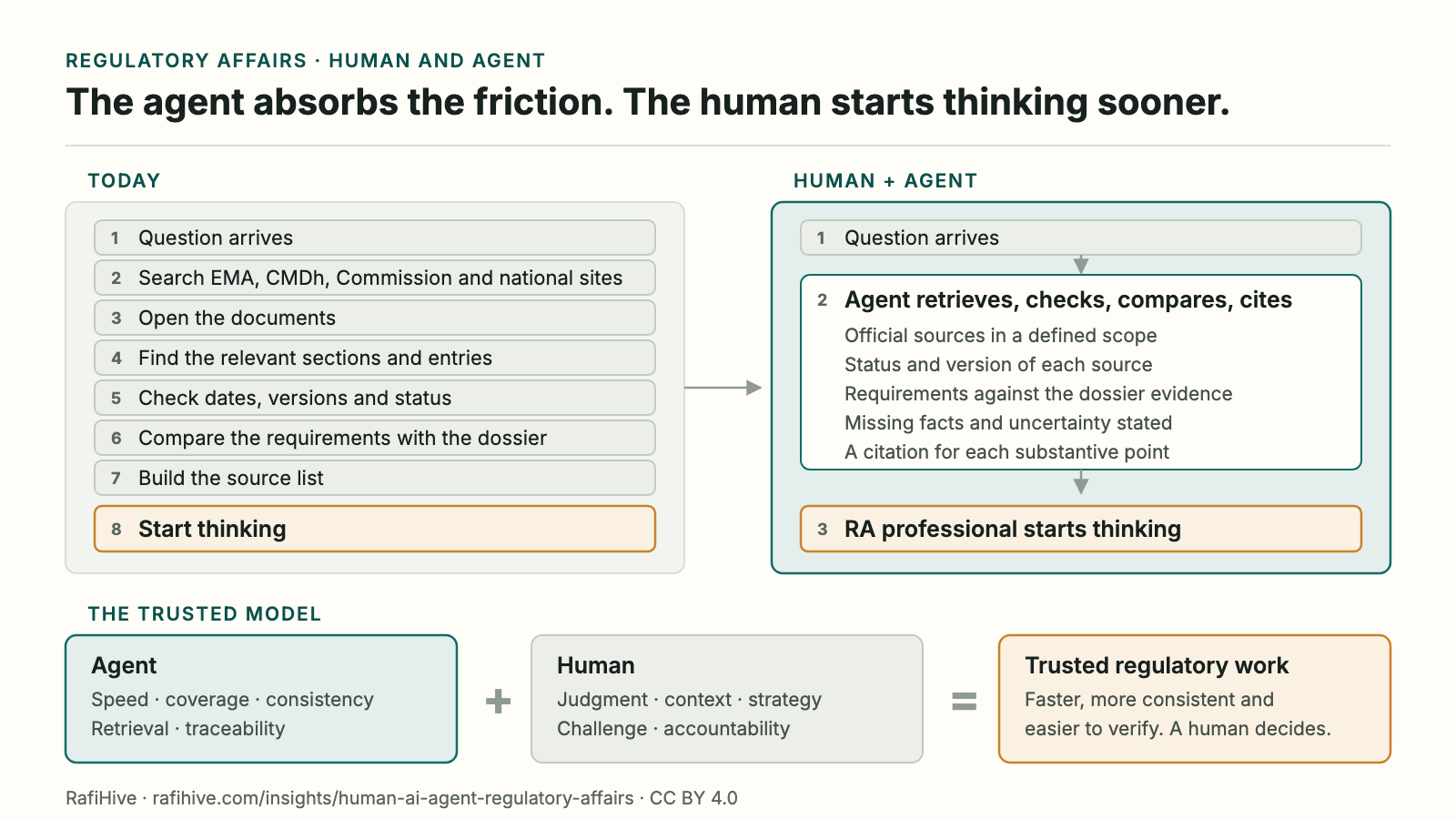
The productivity gain is not that AI makes the decision faster. It is that the RA professional reaches the point where meaningful thinking can begin much sooner.
Today, thinking starts at the end of a chain: search, open the documents, find the relevant sections, check the dates, check the versions, compare the requirements, build the source list. With an agent, retrieval, status checks, comparison and citation happen first, and the professional starts with the evidence already laid out. The diagram at the top of this article shows the difference.
That is a more modest promise than most AI marketing makes. It is also one that can be checked: either the evidence in front of the reviewer is complete, current and cited, or it is not.
If the agent takes away the searching, what should humans do with the time?
Five things, none of which gets smaller when information becomes easier to find.
- Regulatory judgment. Not 'what does the guideline say?' but 'what does it mean for this product, this procedure and these facts?'
- Strategy. Should this change be submitted alone or grouped? Is scientific advice worth asking for? What happens if we submit now rather than in six months? What regulatory risk is acceptable?
- Evidence assessment. An agent can report that document X does not contain evidence Y. A professional decides whether Y needs to be there at all, whether other evidence covers it, and whether the dossier is defensible anyway.
- Cross-functional influence. RA sits between quality, CMC, clinical, safety, labelling, manufacturing, commercial teams and authorities. Getting those groups to a position the company can defend is organisational work an agent does not do.
- Accountability. Someone still has to say: I understand the evidence, and I am prepared to stand behind this regulatory position.
Faster is worthless if the answer is less trustworthy
A useful RA agent cannot simply be a strong language model. A general model can write a plausible regulatory answer from patterns in its training data. A plausible answer is exactly what RA work cannot accept without checking, so the agent's job is to make checking fast. For every substantive point it should be able to show:
- where the requirement came from, down to the passage;
- whether the source is current, superseded or a draft;
- whether it is binding law, guidance, a Q&A answer or procedural advice;
- what evidence supports the conclusion, from the sources and from the dossier;
- which facts are missing;
- where uncertainty remains.
Regulators ask the same of their own staff. The EMA/HMA guiding principles on large language models, first published in September 2024 and written for staff across the European medicines regulatory network, see value in processing extensive documentation, data mining and routine tasks. They also warn about irrelevant or inaccurate responses, and one of their four principles is applying critical thinking and cross-checking outputs. The EMA–FDA guiding principles of good AI practice, published in January 2026, put human-centred design, context of use, performance assessment and lifecycle management at the centre. Our article on what an RA AI agent is covers those principles in more detail.
We do not promise 'more correct'. Correctness still depends on the source set, the facts available, the agent's measured performance and human review. Faster, more consistent and easier to verify is a claim that can be tested.
Decision-ready, not decided
The agent should not aim to produce the decision. It should aim to produce a decision-ready regulatory assessment: the input a qualified professional needs to decide well. That means the question, together with:
- the relevant current sources, with their status;
- the requirements that apply;
- the dossier evidence that bears on them;
- the information that is missing;
- inconsistencies between sources, or between sources and the dossier;
- the possible interpretations where the text allows more than one;
- the uncertainty that remains;
- a citation for each of the above.
The RA professional takes that input and makes the final judgment. Drawing the line there tells everyone, including the agent's designers, exactly where its responsibility ends.
A worked example: adding a finished-product manufacturing site
A company wants to add a new site for the finished product. It is a routine question, and a good illustration of the split.
Without an agent, the RA professional finds the current Commission Variations Guidelines, C/2025/5045, applicable since 15 January 2026. They work out from the site's actual activities whether the change falls under Q.II.b.1, change of the manufacturing site for part or all of the finished product's manufacturing process, under Q.II.b.2, batch release arrangements and batch control testing, or both. Then they check the conditions and documentation for each candidate entry, read EMA's or CMDh's procedural guidance, and check how each site and activity has to be described in the application.
With an agent, the first part takes minutes rather than an afternoon. The agent can:
- retrieve the current classification guideline, not the 2013 version;
- identify the entries that could apply and their conditions;
- surface the documentation each entry requires;
- point to EMA's classification Q&A, which asks for each additional site to be listed as its own entry, with all activities at each site stated;
- ask for the facts it does not have, starting with exactly what the new site will do;
- cite every source, and prepare a first-pass assessment for review.
The professional then decides which entry actually applies, given the complete manufacturing arrangement, and whether the proposed regulatory strategy is defensible. That part did not get shorter. It got the whole afternoon back. Our article on EU variations in 2026 works through the batch release case step by step.
For junior professionals, the agent should be a teacher, not an answer machine
Compare two outputs to the same question.
| Output | What the junior professional learns |
|---|---|
| 'Submit this as Type IB.' | Nothing they can reuse, and nothing they can check. |
| 'These three sources apply, for these reasons. These conditions decide the category. This fact is still missing.' | Which sources matter, how the conditions work and what to ask next time. |
The second output is not slower to read. It is the only one a junior professional can verify, and the only one that builds competence. An RA agent should expose its sources, its reasoning trail, the alternatives it considered and the facts it lacks, so the person using it understands why, not just what.
For senior professionals, the agent should be leverage
A senior RA professional should not spend 90 minutes proving something they already suspect. They should be able to ask: 'Check my assumption against the current EU sources and show me anything that contradicts it.'
That is a different use from the junior one, and just as valuable. The senior professional already has the reasoning. What they lack is time. The agent gives it back for the work only they can do: strategy, risk, negotiation, interpretation, getting stakeholders aligned and dealing with authorities.
Will AI reduce the number of regulatory affairs jobs?
Nobody knows, and anyone who says 'never' is offering reassurance, not analysis.
AI will very likely reduce the manual work many regulatory tasks require. That does not make the need for regulatory judgment disappear. It does mean the value of an RA professional will come more from understanding context, assessing evidence, making decisions and taking responsibility, and less from being the person who can find a specific PDF fastest.
The profession changes when information retrieval stops being scarce. The skills that become more valuable are the ones that were always the point.
The trusted model is not human or AI. It is a human with a bounded agent
Both sides have weaknesses on their own, and they are different weaknesses.
| Working model | Strengths | Weaknesses |
|---|---|---|
| Human alone | Judgment, context, strategy, challenge, accountability | Slow on repetitive checking; can miss an update or a document; limited time |
| AI alone | Speed, coverage, consistency, retrieval, tracking changes, traceability | Can misread context, overstate certainty and fabricate; cannot be accountable; does not see organisational consequences |
| Human with a bounded agent | The agent's speed and traceability, under human judgment and accountability | Only as good as the source set, the agent's measured performance and the review actually done |
'Bounded' is the important word. The agent works from defined sources, shows its evidence, says when it does not know, and stops before the decision. Without those limits, the combination inherits the weaknesses of both sides instead of the strengths.
This is what we are trying to build with RafiHive
We do not think the goal of a regulatory affairs agent should be to remove the regulatory professional from the workflow. The goal should be to remove as much low-value regulatory friction as possible before human judgment is needed.
That is the design RafiHive follows: a reviewed knowledge base of official EU/EEA sources with each document's status and version recorded; citations on substantive claims; your own documents assessed alongside the sources; preset checks that return evidence status, missing information and the reviewer action per finding; a not-found result when the evidence is not there; and a stated boundary that outputs need qualified review and RafiHive does not submit or decide. Our source coverage, evaluation results and AI governance pages set out what is covered, how it is measured and where its limits are.
The RA professional of the future should not be valued for how quickly they can find regulatory information. They should be valued for what they can do once the right evidence is in front of them. Our job is to get it there.
Official sources
- EMA and HMA: Guiding principles on the use of large language models in regulatory science and for medicines regulatory activities
- EMA: Artificial intelligence
- EMA and FDA: Guiding principles of good AI practice in drug development (January 2026)
- European Commission: Variations Guidelines C/2025/5045
- EMA: Classification of changes — questions and answers
Changes since first publication
- 16 October 2026: First published. An evergreen position piece on dividing regulatory affairs work between AI agents and RA professionals, referencing the EMA/HMA guiding principles on large language models and the EMA–FDA guiding principles of good AI practice.
This article supports research and preparation. Confirm current source versions and have a qualified regulatory professional review decisions before use.