
Source-grounded practical guide
ASMF or CEP: documenting the active substance in an EU dossier
How the two active-substance documentation routes differ in practice, what the applicant still owes in either case, and the reference errors that stall validation.
Last reviewed 14 August 2026
Coming with the new EU Directive: EMA-granted active substance master file certificates, alongside the ASMF and CEP routes described here. Not applicable yet. See Annex II and the new master files: the EU dossier is getting modular, not simpler for the implementation overview.
Three routes, one section of the dossier
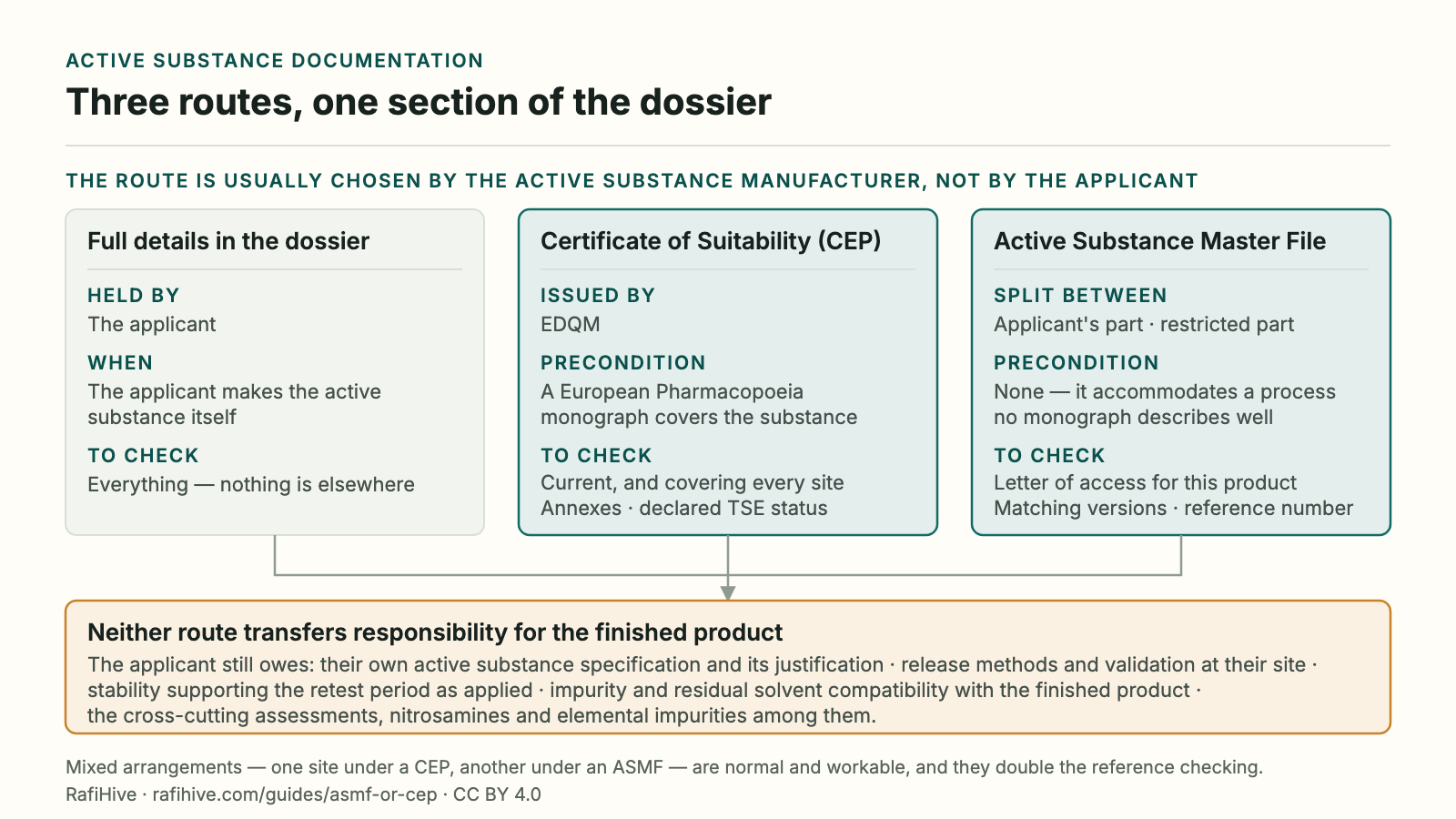
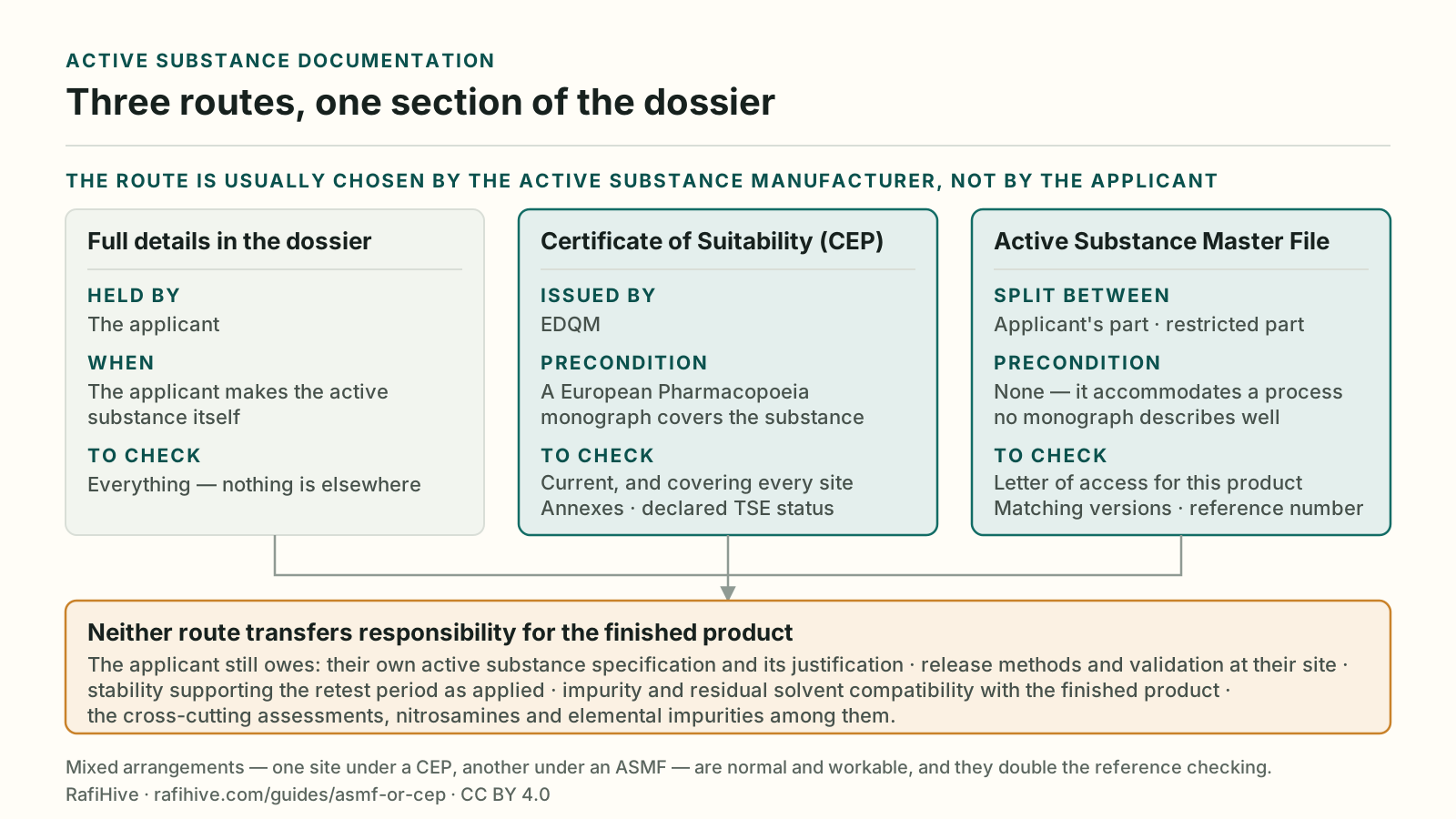
Section 3.2.S of an EU dossier has to describe the active substance completely. There are three ways to get there. Full details can be provided directly in the dossier, which is normal where the applicant makes the active substance itself. A Certificate of Suitability to the monographs of the European Pharmacopoeia, issued by EDQM, can be referenced. Or the Active Substance Master File procedure can be used, splitting the documentation between an applicant's part and a restricted part.
The choice is usually made by the active substance manufacturer rather than by the applicant, and it is often already fixed by the time a regulatory affairs team is involved. What the applicant controls is whether the reference is complete, current and internally consistent — and that is where submissions most often lose time.
The CEP route in practice
A CEP certifies that the quality of the active substance is suitably controlled by the relevant European Pharmacopoeia monograph, together with any additional tests set out on the certificate itself. Referencing it lets the applicant omit much of the corresponding detail from 3.2.S — but not all of it.
Read the certificate rather than filing it. A CEP names the manufacturing site or sites it covers, carries a version and a date, and may carry annexes covering matters such as sterilisation or specific impurity controls. It does not automatically cover a site that has been added since it was issued, and a sterile active substance needs the sterilisation route to be within the certificate's scope or documented separately.
CEPs are revised, and a revision can change what the applicant must hold or state. Where the marketing authorisation references a CEP, keeping that reference current is an ongoing obligation and a revision may require a variation depending on what changed.
- Confirm the certificate is current and covers every manufacturing site used.
- Check the annexes, including any covering sterilisation.
- Confirm the declared TSE status where the substance is of animal origin.
- Record the certificate version and date in the dossier and in your own tracking.
- Identify what the CEP does not cover and provide it in 3.2.S yourself.
The ASMF route in practice
The ASMF procedure splits the documentation. The applicant's part contains the information the applicant is entitled to see and is included in the dossier; the restricted part contains the manufacturer's confidential detail and is submitted by the ASMF holder directly to the authorities. The applicant needs a letter of access from the holder, and the reference has to identify the correct ASMF version.
The mechanics are where submissions fail. A letter of access has to name the applicant, the product and the procedure it applies to, and has to be current — one issued for a different product or a previous procedure is a validation finding. The applicant's part and the restricted part must be the same version of the same file, which requires coordination with the holder rather than an assumption. Where an EU ASMF worksharing assessment has already taken place, the resulting reference number should be quoted.
The practical consequence of the split is that the applicant cannot verify what they cannot see. That makes explicit confirmations from the holder — on nitrosamine risk, on elemental impurities, on changes to the route — part of the applicant's own evidence base rather than a courtesy.
- Letter of access naming this applicant, this product and this procedure.
- Matching version numbers between the applicant's part and the restricted part.
- The ASMF or worksharing reference number, where one exists.
- Confirmation from the holder on nitrosamine and elemental impurity assessments.
- An agreed route for notifying you when the ASMF is updated.
When the choice is genuinely open
Where an active substance manufacturer is willing to work either way, the trade-offs are practical rather than regulatory. A CEP is only available where a European Pharmacopoeia monograph covers the substance, which rules it out for newer actives. Where it is available, it travels well: one certificate can support applications across many markets, and the applicant's dossier section stays comparatively light.
The ASMF route has no monograph precondition and accommodates processes that a monograph does not describe well. It costs more coordination — two parts, two version numbers, a letter of access per application — and the EU worksharing assessment, where it has been used, reduces repeat assessment of the same restricted part across procedures.
For a generic applicant the decision is usually made for them, and the useful question becomes narrower: does this manufacturer keep their documentation current, and will they tell me when it changes? A holder who answers technical questions promptly is worth more over the life of an authorisation than the choice between the two routes.
What the applicant owes regardless of the route
Neither a CEP nor an ASMF transfers responsibility for the finished product. The applicant remains responsible for the suitability of the active substance for their specific product, and for the parts of 3.2.S that sit outside the certificate or the restricted part.
In practice this usually means: the applicant's own active substance specification and its justification, including any tighter limits the product needs; the analytical procedures used for release testing at the applicant's site and their validation; stability data supporting the retest period as applied; the compatibility of the substance's impurity and residual solvent profile with the finished product; and the cross-cutting quality assessments — nitrosamines and elemental impurities among them — which cannot be answered by pointing at the holder alone.
Where a product uses more than one active substance manufacturer, each source needs its own documentation route, and the finished product specification and control strategy have to accommodate all of them. Mixed arrangements — one site under a CEP, another under an ASMF — are normal and workable, but they double the reference checking.
Keeping the reference alive after approval
The active substance documentation is not settled at approval. CEP revisions, ASMF updates, added or withdrawn manufacturing sites and changes to the synthesis route all have consequences for the marketing authorisation, and the appropriate variation category follows from what changed rather than from the documentation route used.
The failure pattern is administrative rather than scientific: the holder updates the file, the applicant is not informed, and the authorisation continues to reference a version that no longer describes what is being supplied. A named contact and an agreed notification route with each holder are worth more here than any internal checklist.
What a structural check catches
Before anyone reads the science, a reference check answers whether the letter of access matches the current application, whether the referenced ASMF version is consistent across the dossier, whether the CEP covers every site named in the application, whether the applicant's own specification and validation are actually present, and whether the cross-cutting assessments have been addressed rather than delegated by implication.
These are the findings that turn into validation questions and lost weeks, and none of them requires access to the restricted part. The scientific adequacy of the active substance documentation, by contrast, is a qualified assessment — confirm the current guidance and have a regulatory professional review the package before submission.
Official sources
Not built yet
Module 3 checks are in development
RafiHive checks EU Module 1 today. Module 3 is what we are looking at next, and what gets built first depends on what actually costs you time. Which Module 3 section costs you the most time?
Live today: the EU eCTD Module 1 gap check runs from your submission context — with your dossier files, or from a declared inventory with no upload at all.
This guide supports research and preparation. Confirm current source versions and have a qualified regulatory professional review decisions before use.