
Source-grounded practical guide
Elemental impurities: making an ICH Q3D assessment hold up
The component-by-component logic behind a Q3D risk assessment, how the numbers are scaled to your daily dose, and what belongs in 3.2.P.5.6 rather than in a supplier folder.
Last reviewed 14 August 2026
What ICH Q3D actually asks for
ICH Q3D requires a risk assessment for elemental impurities in the finished product, covering elements that may be present from any source. It is a risk-based exercise, not a testing programme: the expected output is a documented assessment concluding whether any element requires additional control, and routine testing is the exception rather than the default.
The guideline establishes permitted daily exposures for a defined set of elements, grouped by toxicity and likelihood of occurrence, with different values depending on the route of administration. Revision 2 extended the guideline with permitted daily exposures for the cutaneous and transdermal routes, so a topical product assessed under the original text may need revisiting.
The assessment applies to the product as marketed. Where a product is authorised for more than one route or has more than one strength, the assessment has to hold for each of them — usually meaning the worst case drives the calculation, and that the worst case is stated explicitly.
Where the elements come from
Four sources need to be addressed in every assessment, and the second and fourth are the ones most often thin. Intentionally added catalysts and reagents are usually well documented, because someone chose to add them. Elements present as impurities in the active substance, excipients and water are harder, because they depend on supplier data quality and on excipient origin — mined and mineral-derived excipients are the usual concern.
The third source is manufacturing equipment, where the assessment should reflect actual contact materials, process duration and abrasiveness rather than a generic statement. The fourth is the container closure system, including leachables from elastomers, glass and any coating, informed by the leachables work rather than assumed to be negligible.
An assessment that lists only the active substance and excipients is incomplete on its face, and that is visible without any product knowledge at all.
- Intentionally added catalysts and reagents, at every step retained in the process.
- Active substance, excipients and processing water, with the basis for each figure.
- Equipment contact materials, with the process conditions that justify the conclusion.
- Container closure system, linked to the leachables assessment.
- Every strength and every authorised route of administration.
Choosing an approach and doing the arithmetic
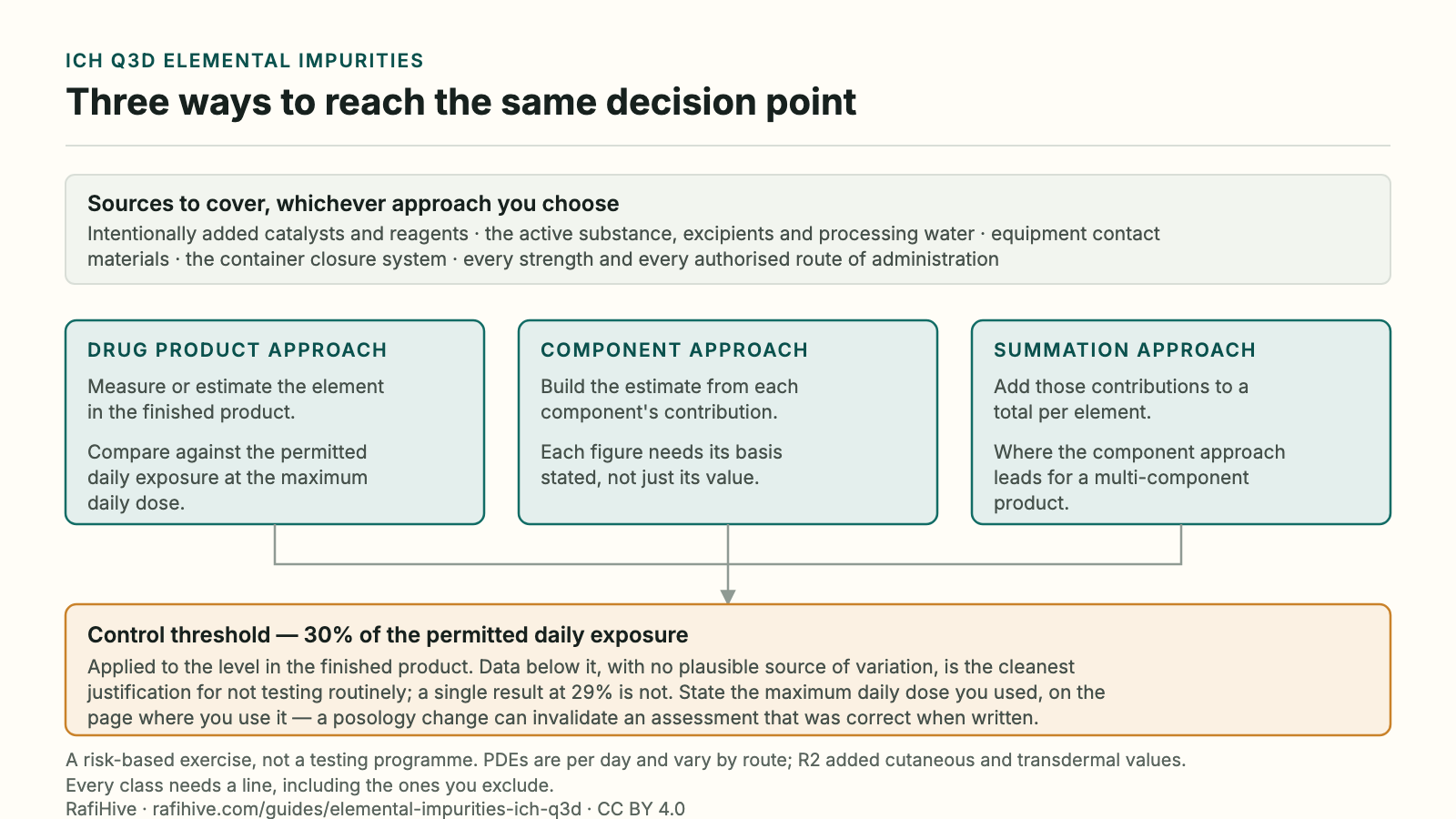
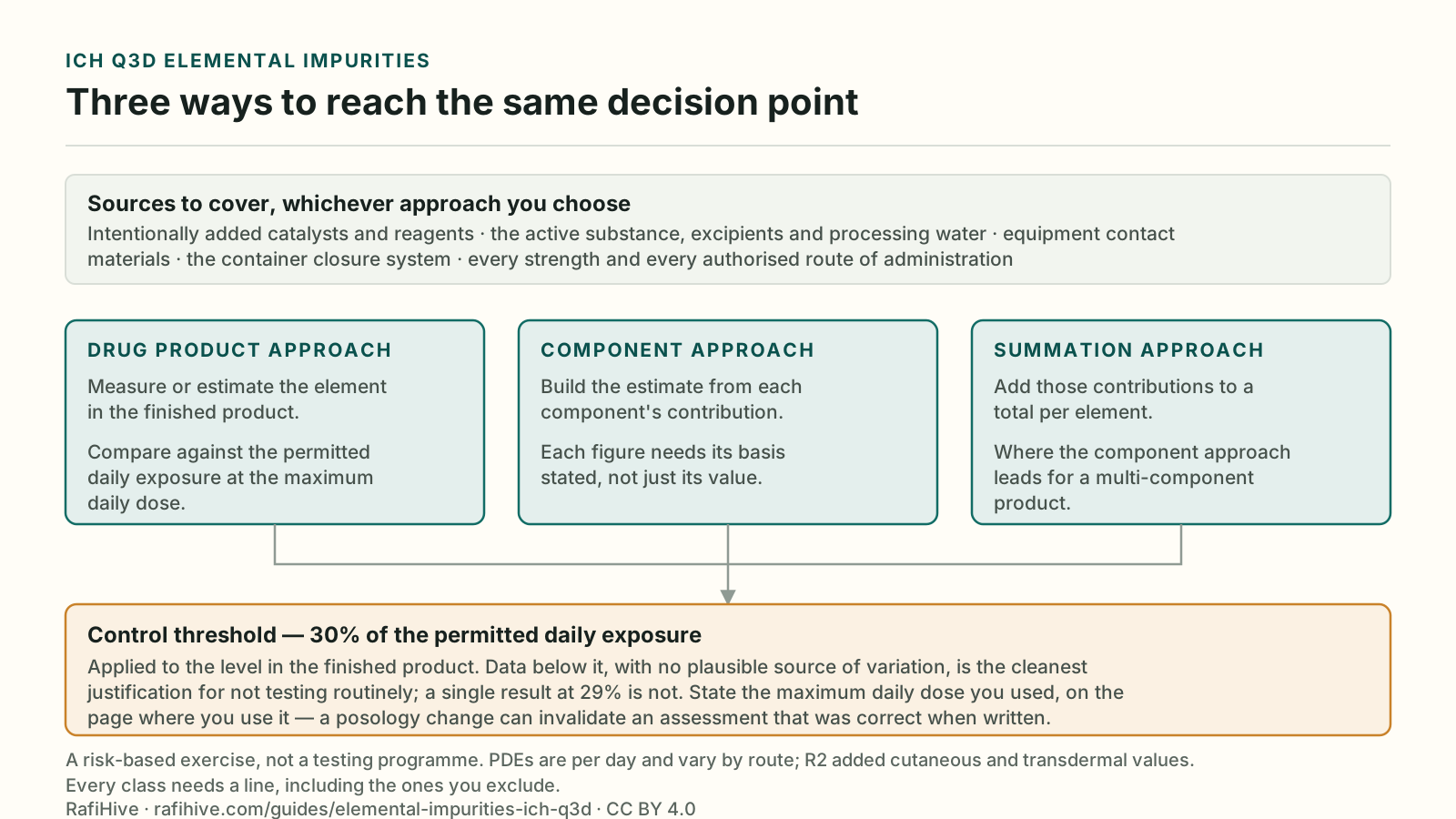
Q3D describes more than one way to reach a conclusion. The drug product approach measures or estimates elements in the finished product and compares against the permitted daily exposure at the maximum daily dose. The component approach builds the estimate from each component's contribution, and the summation approach adds those contributions together to a total per element.
Whichever is chosen, the arithmetic has to be shown. Permitted daily exposures are expressed per day, so the conversion to a concentration depends on the maximum daily dose — which means a change in posology can invalidate an assessment that was correct when written. State the maximum daily dose you used, on the page where you use it.
The control threshold — 30% of the permitted daily exposure — is the decision point for whether additional controls are needed. It is applied to the level in the finished product, and where variability is high the assessment should address the variability rather than rely on a single favourable batch. Data below the control threshold with no plausible source of variation is the cleanest justification for not testing routinely; a single result at 29% is not.
Reading the classes without over-reading them
Q3D groups elements by toxicity and by how likely they are to appear in a pharmaceutical product. The grouping is a tool for deciding how much attention each element deserves — it is not a list of elements you can skip.
Class 1 elements are significant toxicants with limited use, and they are expected to be considered in every assessment because their most common route in is via mined excipients rather than deliberate use. Class 2A elements have a relatively high probability of occurrence and also warrant assessment across all sources. Class 2B elements have a low probability of occurrence and may be excluded unless they are intentionally added at some point in the process — which is exactly why the intentional-addition question has to be asked of every step, including steps performed by a supplier. Class 3 elements have relatively low toxicity by the oral route but need consideration where the route of administration changes that picture, particularly for parenteral and inhalation products.
The common misreading is to treat a low-probability class as a class that needs no statement at all. The efficient version is a short, explicit line per class explaining the basis for exclusion — which costs a paragraph and removes an entire category of question.
Where the data comes from
Most assessments combine three data sources: supplier documentation, published or database values for common excipients, and analytical testing where the first two are insufficient. All three are acceptable. What is not acceptable is leaving the reader unable to tell which one a given number came from.
For analytical work, the European Pharmacopoeia general chapters on elemental impurities set out the methodology and its application, with ICP-MS and ICP-OES the usual techniques. Method suitability should be demonstrated for the matrix in question, and detection limits should be low enough to support a comparison against 30% of the permitted daily exposure — the same sensitivity trap that catches nitrosamine methods applies here.
Where a supplier statement is the basis, record what the statement covers and its date. Elemental impurity profiles follow the mineral source of the excipient; a change in supplier or grade is a reason to revisit, not a paperwork formality.
Where it lands in the dossier
The natural home for the conclusion is 3.2.P.5.6, the justification of specification, where the assessment explains why the finished product specification does or does not include a test for elemental impurities. The supporting reasoning lives in 3.2.P.2 pharmaceutical development, active-substance contributions in 3.2.S.3.2, and the summary in 2.3.P.5.6.
Class 1 elements — arsenic, cadmium, mercury and lead — deserve an explicit statement in every assessment, even a short one concluding they are not expected. Their absence from the discussion reads as an omission rather than as a conclusion.
For authorised products, the assessment is a living document. Adding a supplier, changing an excipient grade, changing the container closure system, or increasing the maximum daily dose all reopen it, and the resulting dossier change is classified from the change itself under the current Classification Guideline.
- 3.2.P.5.6 — the conclusion and its justification.
- 3.2.P.2 — the development reasoning behind the control strategy.
- 3.2.S.3.2 — active substance contribution.
- 2.3.P.5.6 — a summary consistent with the Module 3 conclusion.
- An explicit statement covering the Class 1 elements.
The failures that are visible from the structure alone
A completeness check catches a specific set of problems without needing to judge the science: a component list that omits water, equipment or packaging; an assessment with no stated maximum daily dose; a specification and a justification that disagree about whether routine testing applies; a topical product assessed against a version of the guideline that predates the cutaneous permitted daily exposures; supplier data with no date; a route of administration authorised but not assessed.
None of these require knowing whether your particular excipient is a realistic source of cadmium. They are the mechanical errors that consume validation and assessment time, and they are worth clearing before the dossier reaches anyone whose expertise you actually need.
Whether the risk conclusion itself is sound remains a qualified judgement, made with the full data package rather than from a structural review.
Official sources
Not built yet
Module 3 checks are in development
RafiHive checks EU Module 1 today. Module 3 is what we are looking at next, and what gets built first depends on what actually costs you time. Which Module 3 section costs you the most time?
Live today: the EU eCTD Module 1 gap check runs from your submission context — with your dossier files, or from a declared inventory with no upload at all.
This guide supports research and preparation. Confirm current source versions and have a qualified regulatory professional review decisions before use.